
Being Seen: On Island Community and the Spaces That Hold Us - Reflections on what it means to be witnessed and to belong
Living on a small island teaches you about presence. About the weight of a glance, the meaning of a gesture, the value of a space that knows your name. It teaches you that being seen—truly seen—is not a luxury but a fundamental human need. And that the places where this happens, where we are witnessed and acknowledged, are precious beyond measure.
This understanding came to me in two moments, separated by thousands of miles of ocean but connected by the same truth: that small island communities, at their best, offer something increasingly rare in our fragmented world—spaces where we can be fully present, fully seen, and fully ourselves.
A Bow in the Half-Light
I came to Akakina, on the island of Amami in the southern Japanese archipelago for rest. I had told myself it was to see how the local tourism project worked but by the time I arrived, I knew better: I needed a break. A true holiday by the sea. Sleep. Breathe. Swim. Walk.
And what a place to do it in. Akakina is no tourist town. No shops, a few izakayas. No souvenirs. Just a quiet village with kind people, tucked along the coast. You wouldn't believe how close it is to the airport, to the resort belt. And yet it stays quiet. Untouched.
Even the tourism development project has been done thoughtfully, with guesthouses spread gently across the village and beach. Nothing overbearing. Nothing screaming for attention. The village remains itself.
On my last night I had dinner at the 2 Waters restaurant, in one of the more upmarket beachfront cabins further up the coast. I found myself in a place more beautiful than I expected.
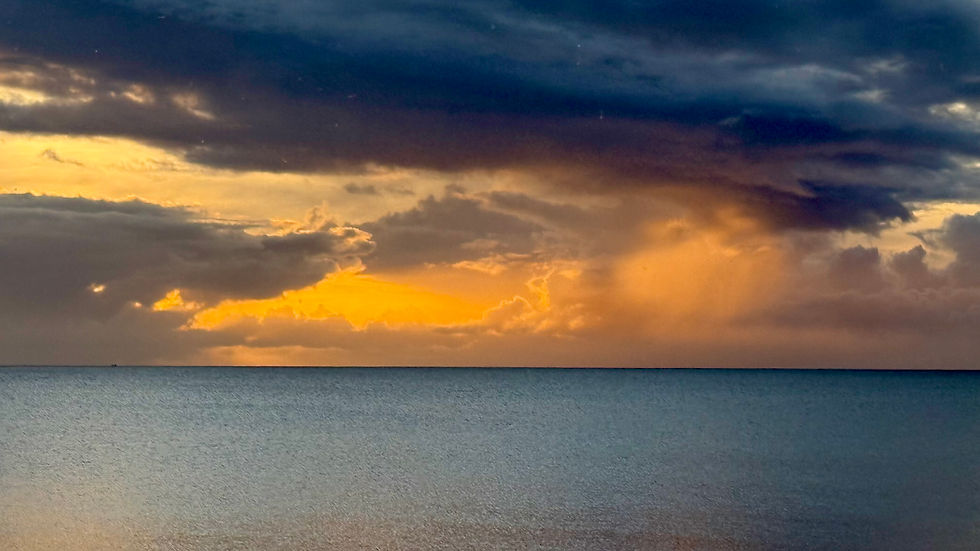
The restaurant faced the sea—just a long wooden bench running the length of glass panes framing the ocean like a painting. Rain clouds moved in. The light dimmed into gold and violet, the seascape in that in-between hour before night.
The food was good, especially that passion fruit sorbet. The view, unforgettable. The girl behind the counter had served me with such welcoming kindness. We exchanged words—my Japanese beginning to come out more easily. It was imperfect, but it was enough to connect. Enough to bring a smile to her face. And mine.
But what happened after dinner—that's what stayed with me.
I was ready to walk back. But the woman—young, with big kind eyes, from Kagoshima but in love with Amami—insisted I take the arranged car.
It's dark now, she said.
The car came. She walked me to it. She bowed. A deep, sincere bow, arms crossed in front of her, spine straight, head low.
I bowed back, thanked her, stepped into the car.
We pulled away. That narrow street curved into the main road. Dusk was deepening. I looked back, just once.
One last glance.
There she was.
Still bowing.
Alone, by the restaurant entrance.
Her small frame, held in that same respectful bend.
A silhouette against the dusk light.
She had no way of knowing I would look back. No one to witness her act of quiet grace. But I did. I saw her. Still, holding that space, for me. And I felt something I hadn't expected.
A gentle tug in my heart.
A kind of quiet astonishment.
A feeling of being deeply acknowledged.
The car continued up the road, but that image remained: the young woman in respectful stillness, holding space for a goodbye that had become something larger than itself.
That night I walked through the village, under red lanterns strung along the seafront. A lovely breeze moved through the trees giving a respite from the day's heavy humidity. I wandered the lanes lined with garden walls, toward the distant sound of laughter and music.
The villagers were gathered near the old sumo ring. There was food, sake, games. A local July red lantern festival. I had seen the morning preparations. It all made sense. Even the mountain shrine lit up the previous night, the bells ringing—part of the celebration, with roots in the time of Satsuma's rule.
The woman at my guesthouse, told me today that the village's name, Akakina, comes from "Aka" for red, fire in Japanese. A place where perhaps a meteor once fell. Fire from the sky.
But that night, the fire was something quieter. Something softer. The fire was that young woman's bow. It stays with me—the image.
A presence offered in stillness.
An acknowledgment without expectation.
A gesture so deeply human.
The Geography of Belonging
That bow taught me something I had been learning slowly, across years of island living and island research: that being seen matters. That acknowledgment, offered freely and completely, is one of the most profound gifts we can give each other.
I chose to live on Waiheke, a small island, because I needed to reintegrate myself back into a community that cares. A sharp detour from my earlier way of thinking that there is no need to belong to a geographically set community, and that one could have a sense of belonging in all sorts of communities, like professional, creative, or activist ones. Having lived on Waiheke for a while now, being born on a Mediterranean island and making a living out of researching and writing about islands, it dawned on me that a community must be geographically bound to be meaningful. That's where you learn that your activism has the most impact, under your feet, on the same piece of land you all share and stand on. That's where you truly learn what tolerance and solidarity is all about. Here on this small island I can flex my social muscles daily in meaningful and rewarding, creative and joyful ways, and where I can rest collectively.
A recent post on Instagram by pat.radicaltherapist making a call for revolutionary rest captured my attention. One of the key elements of this, Pat says, is communal rest which encourages us to find spaces where rest is collective, in the arms of your people, in shared grief, joy and care.
This came at a time when I have been reflecting on the loss of community in this rough post-apocalyptic capitalism era which thrives in social fragmentation and its offerings of consumerism as a replacement of community. As if anything can replace community!
The value community brings to one's life is multiple: building and sustaining strong community ties can help individuals navigate the challenges of disruption, alienating urbanization and advance capitalism while also promoting social cohesion, resilience and well-being.

Tib's Open Air Kitchen: Where Community Gathers
You might be thinking now, what's the link between a bow in Akakina and all this meandering thinking on the value of community? In fact, this thinking was prompted while sitting at Tib's cafe in Oneroa, engaging in all sorts of conversations with Tib and Viola who run this place like an extension of their kitchen and fellow customers. It brought to my attention the value of community based cafes as spaces for collective rest, at the slow pace of a small island where even visitors learn to slow down and re-engage with themselves and others.
The secret to this cafe is Tib and Viola, they host you with joy and care and their beautiful and healthy food, acknowledging your presence in their open air cafe and making an effort to connect and engage in conversations that build a sense of intimacy. Some of the most meaningful conversations I have had lately have been in this cafe with fellow islanders knowing we don't have to finish off the conversation or rush it because here we are on a small rock in the sea where we can pick up from where we left it at another time. And that's what community conversations are all about, taking the time!
What Tib and Viola do is not so different from what that young woman in Akakina did. They see you. They acknowledge your presence. They create a space where you can be witnessed, quietly and completely. Whether it's a bow held in the half-light or a conversation picked up days later over coffee, the gesture is the same: You matter. Your presence here is noted. You are seen.

The Lesson
I left Akakina soon after that encounter. But that bow will stay with me. That silent, unwavering acknowledgment—I see you. Your presence matters.
No words, no grand gestures.
Just a woman in the half-light, honoring a stranger's departure as if it meant something.
And so will the lesson: See others. Let them know they are seen.
Isn't that what we all want? To be witnessed, quietly, completely. To know that for even a moment, we existed fully in someone else's gaze.
Sometimes, that's enough.
This is what small islands offer us, if we let them. Whether it's Amami, Waiheke or any of the countless small islands I've studied and lived on—they teach us the art of being present. Of seeing and being seen. Of creating spaces where community isn't just a concept but a daily practice of acknowledgment and care.
All communities need such good cafes, such generous gestures, such moments of quiet recognition. They need people who understand that the work of community is the work of witness—of seeing each other fully and letting ourselves be seen in return.
To the young woman in Akakina, whoever you were—thank you. I saw you too.
And to Tib and Viola, and to all those who create spaces where island communities can gather and rest and be seen—thank you. You are holding something precious. You are keeping alive the fire that makes community possible.
The fire that, like Akakina's name suggests, comes from the sky but lives in the human heart. The fire of acknowledgment. The fire of being seen.


Comments